 DO NOT TOUCH THE BOARD WHILE THE LOAD IS CONNECTED!
NOTE: This Click board™ needs to be used by trained personnel only while applying high voltages. Special care should be taken when working with hazardous voltage levels.
How does it work?
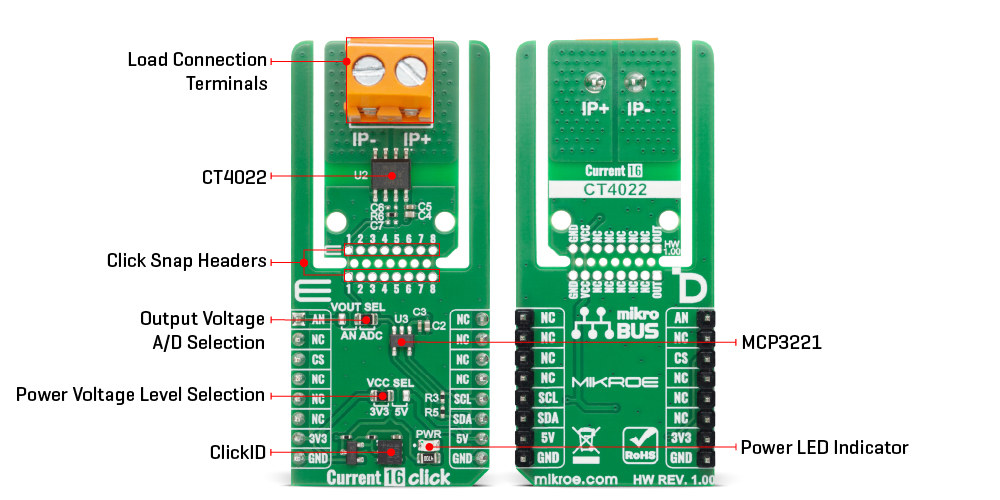
Current 16 Click is based on the CT4022, an isolated 500kHz Tunneling Magnetoresistance (TMR) current sensor from Allegro Microsystems, which offers ultra-low noise and exceptional signal fidelity. It is designed for precise current measurement in demanding industrial and energy conversion applications. Compared to conventional Hall-effect sensors, the CT4022 achieves up to fifteen times lower integrated noise levels, enabling superior measurement accuracy and stability even in noisy environments. This sensor supports a current measurement range of ±12A and provides 3500Vrms isolation voltage with a basic isolation working voltage of 560Vrms, ensuring safe operation in high-voltage systems.
The TMR architecture employs a differential sensing principle that rejects common-mode stray magnetic fields, enhancing measurement reliability and minimizing error sources. The analog output signal from the CT4022 is linearly proportional to the differential magnetic field generated by the measured current, allowing accurate real-time current monitoring with a bandwidth of up to 500kHz. With a primary conductor resistance of just 1mΩ, the sensor minimizes power losses and efficiently handles high inrush currents, making it well-suited for current sensing in datacenter and server power supplies, personal mobility motor drives such as e-bikes and e-scooters, clean energy string and micro inverters, as well as xEV on-board chargers.
This Click board™ is designed in a unique format supporting the newly introduced MIKROE feature called "Click Snap." Unlike the standardized version of Click boards, this feature allows the main sensor/IC/module area to become movable by breaking the PCB, opening up many new possibilities for implementation. Thanks to the Snap feature, the CT4022 can operate autonomously by accessing its signals directly on the pins marked 1-8. Additionally, the Snap part includes a specified and fixed screw hole position, enabling users to secure the Snap board in their desired location.
The CT4022's output signal can be converted to a digital value using MCP3221, a successive approximation A/D converter with a 12-bit resolution from Microchip, using a 2-wire I2C compatible interface, or sent directly to an analog pin of the mikroBUS™ socket labeled as AN. Selection can be performed via an onboard SMD switch labeled VOUT SEL, placing it in an appropriate position marked as AN or ADC.
This Click board™ can operate with either 3.3V or 5V logic voltage levels selected via the VCC SEL jumper. This way, both 3.3V and 5V capable MCUs can use the communication lines properly. Also, this Click board™ comes equipped with a library containing easy-to-use functions and an example code that can be used as a reference for further development.
Click Snap
Click Snap is an innovative feature of our standardized Click add-on boards, designed to bring greater flexibility and optimize your prototypes. By simply snapping the PCB along predefined lines, you can easily detach the main sensor/IC/module area, reducing the overall size, weight, and power consumption - ideal for the final phase of prototyping. For more details about Click Snap, visit the official page dedicated to this feature.
Specifications
| Type |
Current sensor |
| Applications |
Ideal for datacenter power supplies, personal mobility motor drives, renewable energy inverters, and xEV on-board chargers |
| On-board modules |
CT4022 - isolated 500kHz TMR current sensor from Allegro Microsystems |
| Key Features |
TMR current sensor, 500kHz bandwidth, ultra-low noise performance up to fifteen times lower than conventional Hall-effect sensors, differential sensing architecture for common-mode field rejection, 1mΩ primary conductor resistance for minimal power loss and high inrush current handling, analog and digital output proportional to the measured current, onboard MCP3221 12-bit ADC for digital conversion over I2C, Click Snap format, and more |
| Interface |
Analog,I2C |
| Feature |
Click Snap,ClickID |
| Compatibility |
mikroBUS™ |
| Click board size |
L (57.15 x 25.4 mm) |
| Input Voltage |
3.3V,5V |
Pinout diagram
This table shows how the pinout on Current 16 Click corresponds to the pinout on the mikroBUS™ socket (the latter shown in the two middle columns).
| Notes |
Pin |
 |
Pin |
Notes |
|---|
| Analog Output |
AN |
1 |
AN |
PWM |
16 |
NC |
|
| |
NC |
2 |
RST |
INT |
15 |
NC |
|
| ID COMM |
CS |
3 |
CS |
RX |
14 |
NC |
|
| |
NC |
4 |
SCK |
TX |
13 |
NC |
|
| |
NC |
5 |
MISO |
SCL |
12 |
SCL |
I2C Clock |
| |
NC |
6 |
MOSI |
SDA |
11 |
SDA |
I2C Data |
| Power Supply |
3.3V |
7 |
3.3V |
5V |
10 |
5V |
Power Supply |
| Ground |
GND |
8 |
GND |
GND |
9 |
GND |
Ground |
Onboard settings and indicators
| Label |
Name |
Default |
Description |
|---|
| LD1 |
PWR |
- |
Power LED Indicator |
| JP1 |
VCC SEL |
Left |
Power Voltage Level Selection 3V3/5V: Left position 3V3, Right position 5V |
| JP2 |
VOUT SEL |
Right |
Output Voltage A/D Selection AN/ADC: Left position AN, Right position ADC |
Current 16 Click electrical specifications
| Description |
Min |
Typ |
Max |
Unit |
|---|
| Supply Voltage |
3.3 |
- |
5 |
V |
| Current Measurement Range |
-12 |
- |
+12 |
A |
| Bandwidth |
- |
500 |
- |
kHz |
| Galvanic Isolation Voltage |
- |
- |
3500 |
Vrms |
| Basic Working Isolation Voltage |
- |
560 |
- |
Vrms |
| Primary Conductor Resistance |
- |
1 |
- |
mΩ |
Software Support
Current 16 Click demo application is developed using the NECTO Studio, ensuring compatibility with mikroSDK's open-source libraries and tools. Designed for plug-and-play implementation and testing, the demo is fully compatible with all development, starter, and mikromedia boards featuring a mikroBUS™ socket.
Example Description
This example demonstrates the use of Current 16 Click board by reading and displaying the input current measurements.
Key Functions
current16_cfg_setup This function initializes Click configuration structure to initial values.current16_init This function initializes all necessary pins and peripherals used for this Click board.current16_calib_offset This function calibrates the zero current offset value.current16_calib_resolution This function calibrates the data resolution at the known load current.current16_read_current This function reads the input current level [A].
Application Init
Initializes the driver and calibrates the zero current offset and data resolution at 3A load current.
Application Task
Reads the input current measurements and displays the results on the USB UART approximately once per second.
Application Output
This Click board can be interfaced and monitored in two ways:
- Application Output - Use the "Application Output" window in Debug mode for real-time data monitoring. Set it up properly by following this tutorial.
- UART Terminal - Monitor data via the UART Terminal using a USB to UART converter. For detailed instructions, check out this tutorial.
Additional Notes and Information
The complete application code and a ready-to-use project are available through the NECTO Studio Package Manager for direct installation in the NECTO Studio. The application code can also be found on the MIKROE GitHub account.